Essential Study Skills (What Every Student Should Know)
4.3 · 13 teacher reviewsFor a multiple-order discount, email penningtonpublishing7@gmail.com.
Program Description
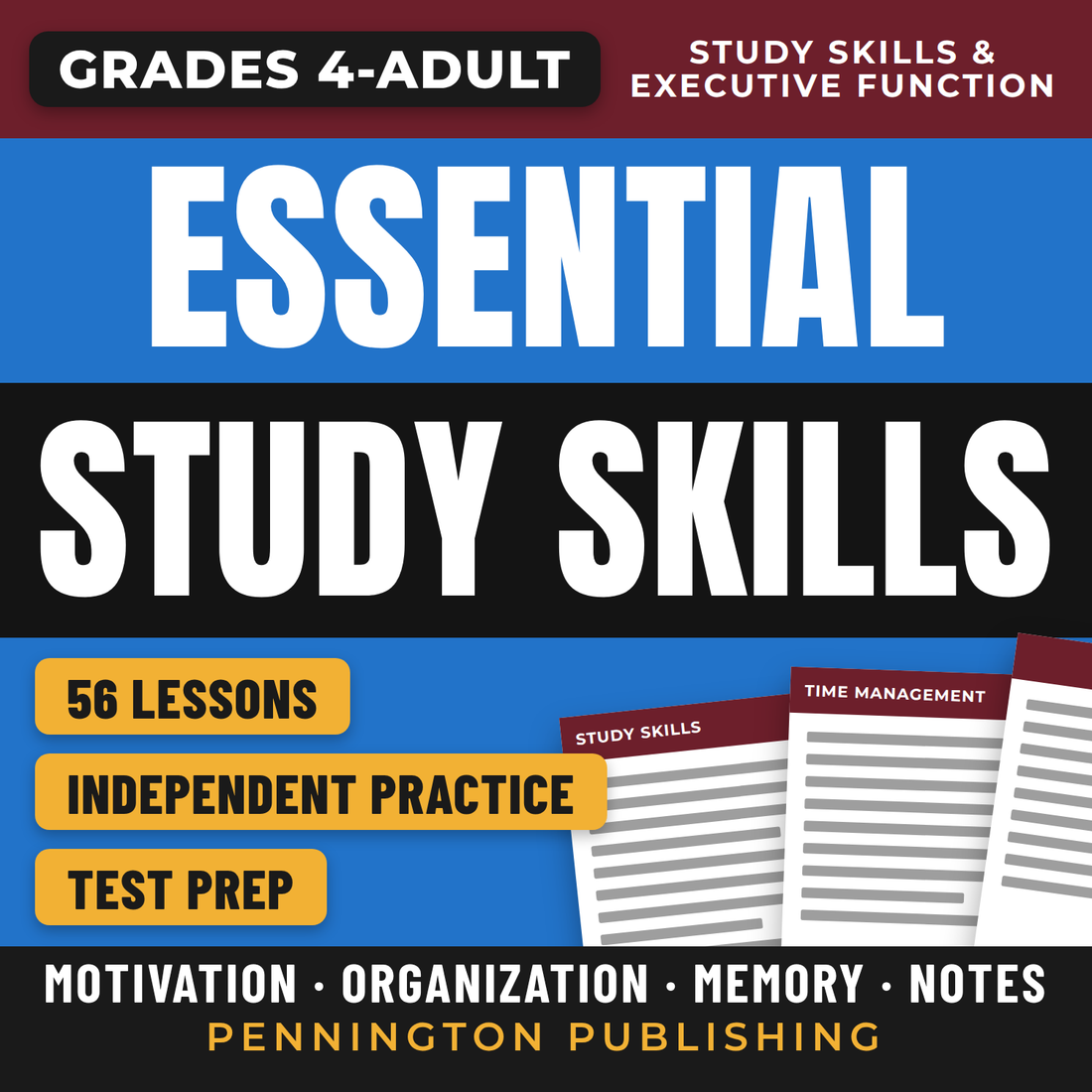
The 56 lessons in Essential Study Skills (What Every Student Should Know) will teach your students the study skills and executive function skills they need to “work smarter, not harder.”
All program components are digital downloads (no print books).
Often, the reason why students fail to achieve their academic potential is not because they don’t try hard enough, but because they have never learned the basic study skills necessary for success. Students who master these skills will spend less time and accomplish more during homework and study time. Their test study will be more productive and they will get better grades. Reading comprehension and vocabulary will improve. Their writing will make more sense and essays will be easier to plan and complete. They will memorize better and forget less. Their schoolwork will seem easier and will be much more enjoyable.
Lastly, students will feel better about themselves as learners and will be more motivated to succeed. Ideal curriculum for study skill, life skill, advocacy/advisory, opportunity program classes. The easy-to-follow lesson format of 1. Personal Assessment 2. Study Skill Tips and 3. Reflection is ideal for self-guided learning and practice. Plus, this digital download (eBook) provides helpful online links to add to the study skill lessons.
Great for independent work during small groups, study skills electives, substitute lesson plans, rainy day activities, advocacy or advisory classes.
Want to view lesson samples? Preview This Book
Table of Contents
Motivation
1. How to Get Motivated
2. How to Prevent Procrastination
3. How to Set Goals
4. How to Develop a Positive Mental Attitude
Organization and Time Management
5. How to Create a Home Study Environment
6. How to Get Organized for Homework
7. How to Complete a Daily Review
8. How to Manage Time for Homework
Reading Strategies and Skills
9. How to Choose Books for Independent Reading
10. How to Develop Good Reading Habits
11. How to Improve Oral Reading Fluency
12. How to Improve Silent Reading Fluency
13. How to Read Interactively
14. How to Improve Reading Comprehension
15. How to Make Inferences
16. How to Use Marginal Annotations
17. How to Read Non–Fiction Textbooks
18. How to Identify the Main Idea
19. How to Complete a Close Reading for Narrative Text
20. How to Complete a Close Reading for Expository Text
21. How to Use Context Clues
Research
22. How to Quote and Cite Textual Evidence
23. How to Identify Bias and Errors in Reasoning
24. How to Research Safely and Evaluate Internet Sources
Memorization Strategies
25. How to Memorize with the Grouping Strategy
26. How to Memorize with the Association Strategy
27. How to Memorize with the Linking Strategy
28. How to Memorize with the Catch Words Strategy
29. How to Memorize with the Catch Sentence Strategy
30. How to Memorize with the Location Strategy
Essay Writing
31. How to Dissect a Writing Prompt
32. How to Write a Thesis Statement
33. How to Avoid Errors in Writing Style
34. How to Follow Essay Writing Rules
35. How to Write an Essay Introduction
36. How to Write Essay Body Paragraphs
37. How to Write an Essay Conclusion
38. How to Write in Complex Sentences
Listening and Note–taking
39. How to Practice Active Listening
40. How to Take Notes
41. How to Organize Cornell Notes
42. How to Organize Formal Outline Notes
Grammar, Spelling, and Mechanics
43. How to Identify and Use the Parts of Speech
44. How to Use Grammatical Sentence Openers for Sentence Variety
45. How to Use Precise Verb Tenses
46. How to Eliminate the “to be” Verbs
47. How to Spell by the Rules
48. How to Apply the Syllable Rules
49. How to Punctuate Properly
50. How to Capitalize Correctly
51. How to Avoid Non-Standard Usage
Test Preparation and Test–taking
52. How to Prepare for Tests
53. How to Use Objective Test–taking Strategies
54. How to Use Matching Test–taking Strategies
55. How to Use Fill–in–the–Blank Test–taking Strategies
56. How to Use Multiple Choice Test–taking Strategies
Plus, a 56-item Study Skills and Executive Function Skills Self-Assessment and Mastery Matrix. You, your students, and their parents will love the 56 lessons in Essential Study Skills.
What teachers say
All reviews“I used this to teach my 7th grade students study skills and executive skills. Some of the materials were too basic and/or not engaging enough for squirmy middle school students but overall I was able to implement in my class which was helpful”
“Very helpful resource for students who are struggling with grammar and study skills”
“An excellent activity for middle school! Easy to prep!”
“This has a lot of great information for students with executive functioning needs or who are unsure of how to stay organized in the classroom setting. Lots of great activities and ideas here”
“I used this for a Study Skills elective I had to teach. The content is high quality, and I like that it got students writing. I had to supplement some activities to keep things from being repetitive, but I would have to do that with a textbook. This gave me something to work from”
“I review the material with my freshman study skills students”
“Great for my high school students!”
“I teach a study skills class for 7th and 8th graders and this has helped me shape the curriculum for the class. Thanks!”
“Very comprehensive. Thanks very much.”
“I used this with my Study Skills class. Straight forward, easy to use.”
“This was a huge time saver! Very useful for my College Success course. I appreciated the organization and the format of the lessons.”
“Use with both my study skills and reading remediation classes. Wonderful resource!”
“This is a fantastic, comprehensive resource that will help not only with completing homework, but also with learning skills that will help students be successful in all classes.”
FAQ
Questions teachers ask
How many lessons are there and what do they cover?
There are 56 lessons covering study skills and executive function skills. The sections are motivation, organization and time management, reading strategies and skills, research, memorization strategies, essay writing, listening and note-taking, grammar, spelling and mechanics, and test preparation and test-taking.
What is the format of a lesson?
Every lesson follows the same three-part format: a personal assessment, study skill tips, and a reflection. The consistent structure is meant to work for self-guided learning and practice.
Is there a way to measure what students already know?
The program includes a 56-item Study Skills and Executive Function Skills Self-Assessment and Mastery Matrix, matched to the 56 lessons.
What kind of class is this meant for?
It is written as curriculum for study skills, life skills, advocacy or advisory, and opportunity program classes. Teachers also use it for independent work during small groups, study skills electives, and substitute lesson plans.
Can students work through it on their own?
Yes. The assessment, tips, and reflection format is designed for self-guided learning, and the digital download includes online links that extend the study skill lessons.
Can I see the lessons before buying?
Yes. A free preview of the entire program is available from the product page. All components are digital downloads, so no print book is shipped.