Syllables and Morphology
For a multiple-order discount, email penningtonpublishing7@gmail.com.
Program Description
Learning to divide words into parts helps speed students speed up the process of decoding. Once the basic phoneme (speech sounds) are mapped to common spellings, students improve reading automaticity by learning to recognize common syllables by sight. Additionally, knowing the rules for syllable division helps students read words with greater accuracy.
Click HERE to preview these lessons. Note these lessons are included in The Science of Reading Intervention Program: Assessment-Based Instruction.
Of course, studying the meanings of syllables (morphemes) is also essential. In a nutshell, a morpheme is defined as a meaningful word or word part which cannot be divided. There are two types of morphemes: free and bound. A free base is a morpheme that stands on its own as a word, for example, view. A bound base is a morpheme that cannot stand on its own as a word, for example, vis. Prefixes and suffixes are bound morphemes, for example, pre in preview and it in visit, and so must be connected to free or bound bases.
Recent studies have demonstrated that morphological awareness has a significant impact on reading ability (Gottardo, Mirza, Koh, Ferreira, and Javier, 2018; Zhang and Ke, 2020).
Additionally, lack of morphological awareness is highly correlated with reading difficulties and seems to be related to both word recognition and language comprehension (Duke and Cartwright, 2021).
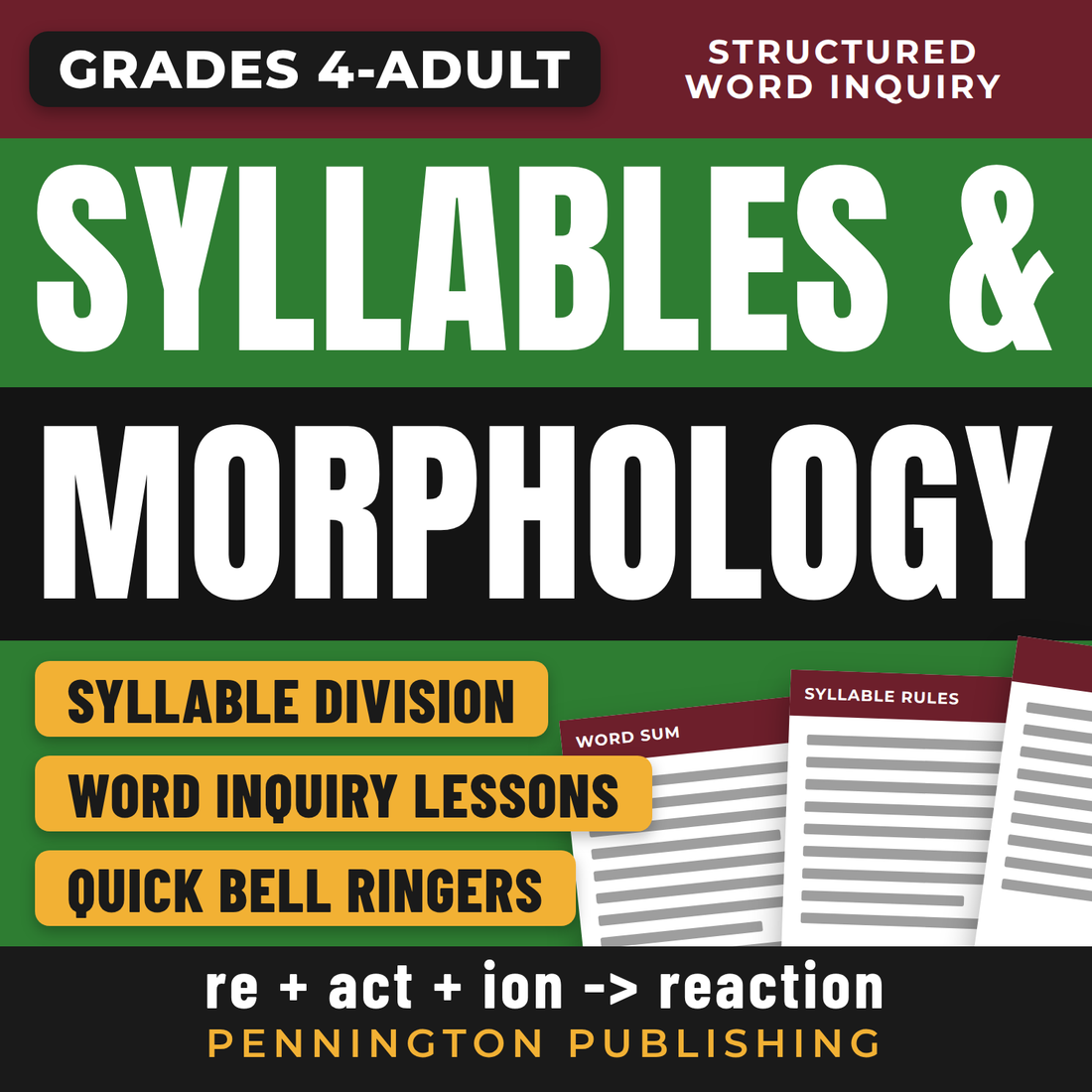
In the following lessons, students will learn the key syllable patterns and how they affect syllable division and recognition. The teacher teaches the pattern and helps students blend multi-syllabic words, syllable by syllable. Students practice using the pattern and syllable division with a worksheet.
Additionally, these worksheets will introduce students to derivational influences and patterns in our language. Students will learn and practice vowel and consonant shifts and accent shifts as one word morphs into another related word. For example, students will analyze word cousins such as méd/ic, méd/i/cal, méd/i/cine, me/dí/ci/nal, me/di/cá/tion.
Each lesson also includes a Structured Word Inquiry exercise to build words from one of the lesson’s bound bases. The teacher displays the Structured Word Inquiry box on the whiteboard, which includes the bound base and definition. Students brainstorm prefixes, suffixes, and other bound bases from the Word Part Bank to add to the bound base, and the teacher writes these on the whiteboard. Students say each newly constructed word in unison, and the teacher asks the students to provide sentences using the word.
Lessons include the following syllable patterns:
- Closed
- Open
- Silent final e
- Vowel teams
- r-controlled
- Double consonants
- Inflected endings
- Schwa
- Consonant-le
- Vowel pronunciation shifts
- Consonant pronunciation shifts
- Accent shifts
- Prefixes
- Suffixes
FAQ
Questions teachers ask
Which syllable patterns are covered?
Closed, open, silent final e, vowel teams, r-controlled, double consonants, inflected endings, schwa, and consonant-le, along with vowel and consonant pronunciation shifts, accent shifts, prefixes, and suffixes.
What does a lesson look like?
The teacher teaches the pattern and helps students blend multi-syllabic words syllable by syllable, then students practice the pattern and syllable division with a worksheet.
What is the Structured Word Inquiry exercise?
Each lesson includes one. You display the Structured Word Inquiry box with a bound base and its definition, students brainstorm prefixes, suffixes, and other bound bases from the Word Part Bank, the class says each new word in unison, and students use the words in sentences.
Why teach morphology alongside syllables?
The lessons cite research that morphological awareness has a significant impact on reading ability and that a lack of morphological awareness is highly correlated with reading difficulties in both word recognition and language comprehension.
Does this teach how words change form?
Yes. The worksheets introduce derivational influences and patterns, including vowel and consonant shifts and accent shifts as one word morphs into a related word, for example medic, medical, medicine, medicinal, and medication.
Is this material part of a larger program?
Yes. These lessons are also included in The Science of Reading Intervention Program: Assessment-Based Instruction.